Explore professional services

Hospitality technology delivery

Connected solutions for working hotels

A hotel network serves more than guest Wi-Fi. Front desk and back-office teams, room technology, security and building systems all depend on it. T2Core plans the connections, separates access where needed and coordinates technical work around a live operation.

Work can be scoped as one network layer or as a coordinated set of workstreams. T2Core applies design, delivery and assurance where the project needs them; appointed platform providers retain responsibility for their own systems.

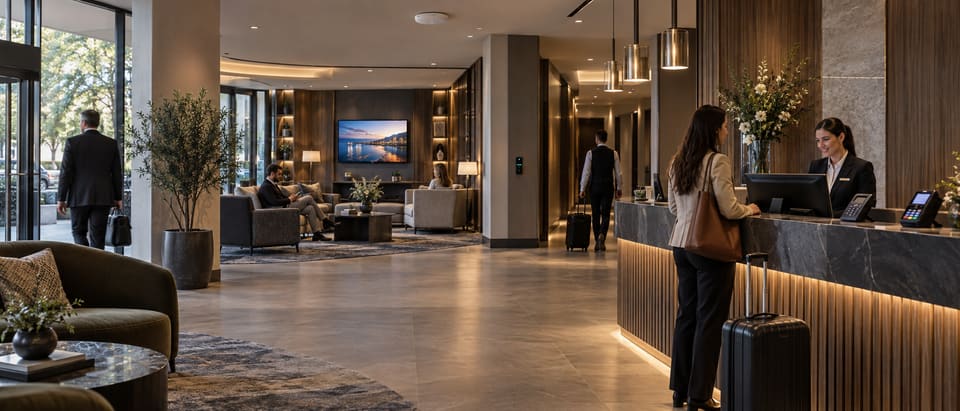
Hotel lobby with reception systems, guest payment terminal, digital display, corridor access reader and ceiling wireless access point.

Where this work applies

  • New openingsDefine the network and connected-system readiness needed before rooms go live.
  • RefurbishmentsPhase changes around guests, staff and services that must keep working.
  • Upgrades and rolloutsPilot a repeatable change, check the result and manage exceptions across sites.

One property, connected work

Hotel network infrastructure supports more than guest Wi-Fi

Select a point to see its network detail.

Guest accessSeparated

Kept within the access boundaries agreed for guest services.

  • Kept within the access boundaries agreed for guest services.

  • Staff devices and comms-room servers connected within agreed access and security boundaries.

  • Capacity and traffic treatment agreed with the appointed voice provider.

  • IPTV, RF and satellite feeds need clear headend and room routes; casting needs device isolation.

  • A route from the content source to each display.

  • Kept on their own segment, with the provider’s interface clear.

  • CCTV, music and building systems reachable by the people and suppliers responsible for them.

T2Core's contribution

How T2Core supports a hotel project

A hotel’s staff and administration networks are as important to daily operations as its guest-facing systems. Service providers need to understand how this wider infrastructure supports what they deliver, even when work on it falls outside their usual scope. T2Core provides the design, migration, coordination, testing and handover support to address that gap.

  1. Network design and segmentation

    Map the incoming service, comms rooms, switching, wireless and connected endpoints. Define how guest, staff and operational traffic should share or separate the backbone, including supplier access and security boundaries.

    Typical output: Network and interface plan, with assumptions and access boundaries recorded.

  2. Migration and change planning

    Review the existing network and the standard it needs to move to. Plan cutover, coexistence, testing and rollback around occupied rooms, working teams and services that cannot simply be switched off.

    Typical output: Phased migration route, cutover checks and a clear fallback position.

  3. Supplier and project coordination

    Bring hotel IT, installers and specialist providers into one technical plan. Record who provides each circuit, port, route or platform interface, and when access and rooms must be ready.

    Typical output: Named owners, dependencies, readiness dates and exception actions.

  4. Review, testing and handover

    Examine segmentation and security assumptions, investigate faults that cross supplier boundaries, check the agreed connections and record results, exceptions and support ownership.

    Typical output: Test evidence and a known state the operating team can use.

01Hospitality technology delivery

Network Backbone & Connectivity

One backbone for staff, guest and operational networks

Network engineering for a hotel starts with the physical and logical infrastructure, from the incoming service and main comms room to staff, guest and specialist endpoints. This network infrastructure is not a guest network: it can support distinct administration, guest and operational networks over shared or separate routes, with agreed boundaries.
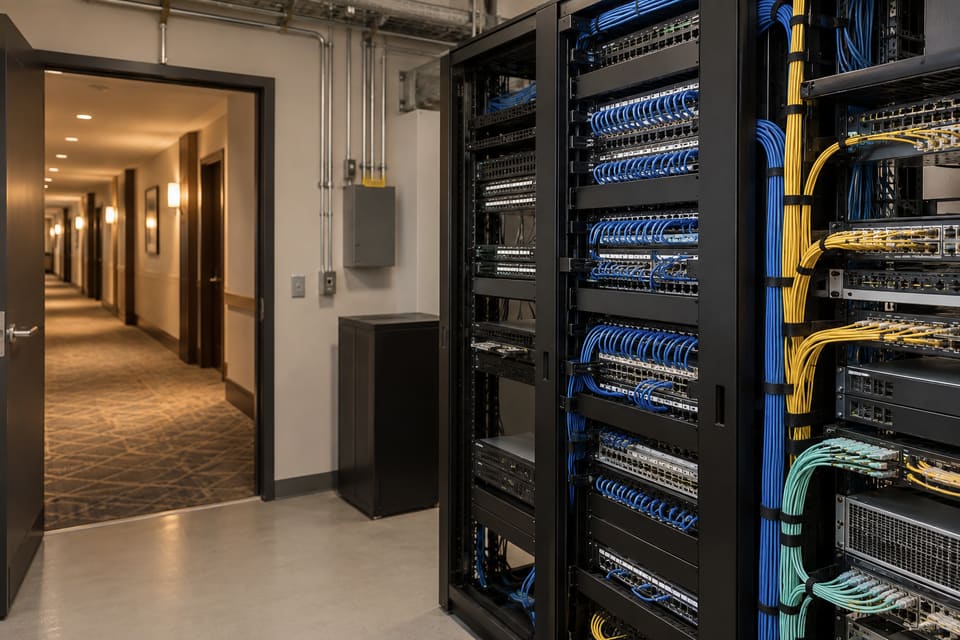
Hotel comms-room racks with network cabling beside a corridor.

Tap a numbered point in the diagram to view its detail.

  1. Confirm network needs, service handoff and ownership.

  2. Separate staff, guest and operational traffic; agree access boundaries.

  3. Plan fibre, copper and switching capacity, with room to expand.

  4. Check outlets, power and access; record test evidence.

Areas can include:

  • internet and WAN readiness, carrier handoff and service dependencies
  • LAN architecture, switching, routing, addressing and segmentation
  • routes and capacity for staff, guest and operational network segments
  • comms-room connectivity for servers, back-office systems and specialist platforms
  • firewall and security boundaries within the agreed network scope
  • equipment rooms, cabinets, racks, containment, power and resilience
  • fibre infrastructure, including GPON and active-Ethernet or point-to-point designs
  • copper structured cabling, normally Cat6 or Cat6A
  • capacity, expansion and replacement planning
  • network and security reviews, upgrades, phased migration, commissioning and remediation
  • repeatable delivery standards where work spans several locations
  • topology, labelling, test evidence and known-state documentation

Where a carrier, specialist installer or third-party system is involved, T2Core helps connect that contribution into the wider design, checks agreed network and security boundaries, confirms readiness and keeps the handoff clear.
02Hospitality technology delivery

Staff & Operational Networks

Put the hotel’s agreed network standards into practice

The administration LAN and operational systems may use dedicated infrastructure or defined segments on the shared backbone. T2Core can survey the existing estate, install and configure network and firewall components within the agreed scope, and implement the access rules set by the hotel or security owner.

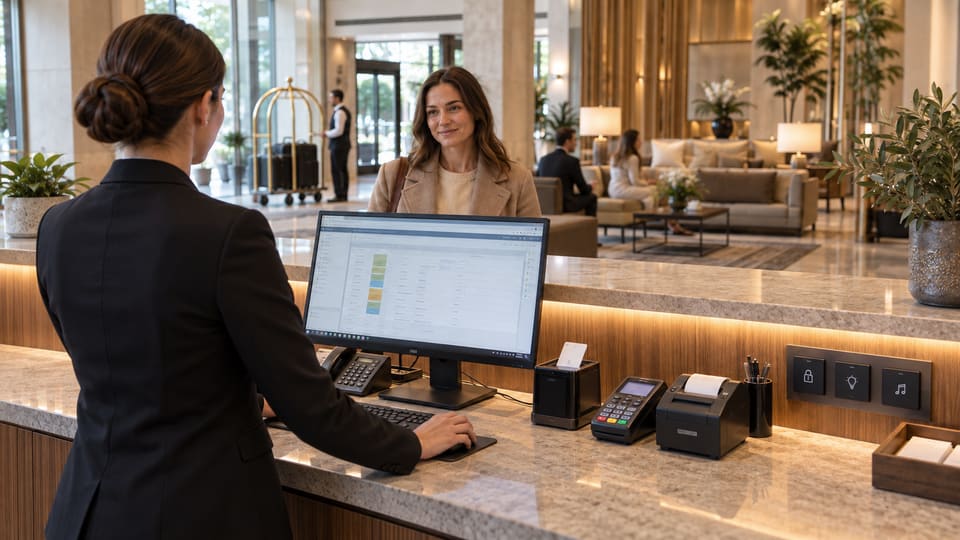
Standing receptionist using a hotel workstation with computer, desk phone, keycard encoder, payment terminal, printer and building controls.

Staff & administration

Servers in the comms room, staff PCs, printers, voice and the network interfaces used by PMS and POS providers.

Property operations

Connectivity and agreed boundaries for CCTV, access control, music, building systems and appointed specialist suppliers.

Security boundaries

Segmentation, firewall deployment or change, supplier access and validation against the standards agreed for the site.

Work can include

  • administration-LAN surveys, design and migration planning
  • staff and back-office switch, port and connection readiness
  • network segmentation and firewall installation or configuration in scope
  • supplier access, interfaces and change windows
  • testing of agreed access paths and security boundaries
  • topology, configuration records and known-state handover

T2Core implements and verifies the agreed network scope. Ongoing management of servers, staff devices, applications and security policy remains with the hotel or its appointed provider.

03Hospitality technology delivery

Wireless Solutions

Wireless design grounded in measurement, use and site reality

Wireless design starts with how guest, staff and operational spaces are used and how access points will connect to the backbone. Coverage is one part of the requirement; capacity, interference, roaming, cabling, switch capacity, power and physical access also shape the result.

Tap a numbered point in the diagram to view its detail.

  1. Confirm users, devices, intended use and constraints.

  2. Locate service handoff, cabinets, routes, outlets and power.

  3. Measure current coverage where a baseline is needed.

  4. Plan access-point positions, capacity and supporting infrastructure.

  5. Install, configure and integrate the agreed solution.

  6. Test against agreed objectives and document the result.

The journey can include:

  1. Visit and understand the intended use, users, devices and constraints.
  2. Locate incoming connectivity, cabinets, routes, outlets, switching and available power.
  3. Assess the existing wireless environment where a baseline is required.
  4. Design access-point positions, coverage, capacity and the supporting infrastructure.
  5. Prepare or remediate data points, containment, switching or power where contracted.
  6. Deploy, configure and integrate the agreed solution.
  7. Validate against the agreed objectives and document the outcome.
  8. Apply a consistent deployment and validation method where several locations are involved.

The survey type and validation method should match the decision being made. A predictive model, an on-site survey, a post-installation validation and fault investigation provide different evidence and should not be presented as interchangeable.

04Hospitality technology delivery

TV, Casting & Media Distribution

Design the path from content and services to the screen

Hotel television and casting depend on the whole path from satellite feed or content source to headend, distribution, network and room screen. IPTV and RF/coax need different infrastructure, while casting adds wireless, pairing and isolation requirements. Content rights and appointed platform responsibilities remain with the relevant providers.

Tap a numbered point in the diagram to view its detail.

  1. Confirm content sources, platforms and provider responsibilities.

  2. Design IP, RF/coax or hybrid distribution.

  3. Check capacity, segmentation, multicast, outlets and power.

  4. Plan displays, guest casting, isolation and signage placement.

  5. Commission and validate; manage only where agreed.

Areas can include:

  • satellite feed reception and the agreed handoff to television headends
  • IPTV and RF headend design, installation and commissioning where contracted
  • RF/coax infrastructure build, testing and hybrid or IP distribution
  • IPTV, connected-TV and in-room TV connectivity
  • guest casting, pairing and device-isolation requirements
  • digital signage, information displays and content placement
  • network, internet, Wi-Fi, bandwidth and integration dependencies
  • display, outlet, power, access, room-readiness and containment requirements
  • configuration, commissioning, validation and documentation
  • technical advice shaped by hospitality operating experience
  • platform administration and ongoing management remain with the appointed provider

T2Core coordinates the technical path around content, licences, subscription services and third-party platforms, with each provider’s contribution connected into the project plan.

Hospitality technology delivery

Technical support for a working hotel.

From network design to a verified handover.

We help hotel project teams and their technology partners plan and deliver the infrastructure behind guest, staff and operational systems. The work is scoped around the property, its suppliers and what must stay running.

Explore project support

Tap a numbered point in the diagram to see its key dependency.

Shared site, programme and interfaces

TV & casting

Depends on
Room readiness
Lands in
Guest rooms

Screens and casting rely on room access, outlets, network capacity and the platform provider's interface.

If rooms are not finished and connected in time, TVs cannot be set up and tested before guests arrive.

Wireless

Depends on
Network readiness
Lands in
Ceiling voids

Access points need data points, switch capacity and power in place before coverage can be validated.

If cabling or switches are late, the Wi-Fi cannot be proven before people start relying on it.

Voice

Depends on
Supplier interface
Lands in
Reception

Handsets and lines depend on the appointed provider, priority on a shared network and an agreed changeover.

Phones need to keep working on the day the old service is switched off.

Network

Depends on
Service handoff
Lands in
Comms room

The incoming service, core network and comms-room servers need to be ready for staff and other systems across the site.

Third-party systems

Depends on
Validation
Lands in
Room controls

Other suppliers' systems join at agreed interfaces and are tested before anything is handed over.

Problems where two systems meet are found before handover, not after the site opens.

Operational systems

Depends on
Site access
Lands in
Back of house

Building and operational systems bring their own suppliers, access windows and remote-support needs.

Work has to be planned around the other trades on site and the people running the building.

Digital signage

Depends on
Content path
Lands in
Meeting spaces

Displays need power, a network route and a clear owner for the content and the platform behind it.

A screen can be installed and still show nothing useful if no one is responsible for what appears on it.

Payment

Depends on
Segmentation
Lands in
Point of sale

Terminals sit on their own segment, with the boundary to the payment provider made explicit.

Card payments stay separate from guest and staff traffic, and it is clear who looks after which part.

The same delivery discipline, applied to the hotel

Survey, design, coordination, deployment, validation and handover are adapted to the work, the property and its live operation.

Explore how we deliver

Buyer questions

Before you get in touch

Can T2Core support a new opening or refurbishment?
Yes. Support can start with site readiness and design coordination, then continue through installation, commissioning and handover.
Does T2Core supply equipment or work with an appointed platform provider?
Yes. T2Core works with all major technology suppliers and can deliver solutions based on your preferred platforms, equipment and project requirements. We can also work alongside providers you have already appointed.

Discuss a project

Start with the outcome or problem

You do not need to choose a category or arrive with a complete scope. Describe what you are planning, where delivery is under pressure or what is not working as expected, and T2Core will identify the most useful next conversation.